

Japanese and Chinese art are very similar. Chinese art held much meditation, focusing on one subject, mostly nature. They use to focus on human figures, yet changed to nature for the peaceful meanings behind them. Chinese time periods are divided into Dynasties, having various emperors for each one. One of the earliest forms of Chinese art was sculpture, yet later painting grew in vitality. The paintings held a very known perspective with as much negative space as positive space. Landscaping is common as well, portraying nature in a harmonic, comfort promoting way. Japanese art is like Chinese art in many ways. Most Japanese art held a purpose behind the beauty, such as the warrior suits, pipe cases, and swords. They tended to be of nature colors, sometimes a vivid color thrown in to contrast, with functional reasons as well as mental reasoning. They used woodblock prints as their signature, such as the prints of African art, yet etched within the block instead of protruding out. One example to the left, is The Great Wave by Hokusai, demonstrating the use of not only woodblocks, yet the power of nature as well. Scrolls were painted and tucked away, used as leisure enjoyments for meditation, similar to the American novel. Quite a few American artists were inspired by the Japanese artists. These paintings held signature view points that were uncommon to the world. This let their paintings put the feel as though the viewer was truly inside the picture, told a sense of motion, portrayed a value of textures, or any number of reasons to demonstrate the culture of perspective. All pictures had some for of nature within, showing it's power and overall control over humankind. This belief derived from the fact Japan consists of many island, being exposed to many natural disasters. Japanese and Chinese art are more different from the wor
 ld than similar, shining their heritages through each masterpiece.
Terracotta soldiers (an exmaple to the right) were made in pieces and put together to be buried with an emperor named Quin Shi Huang Di for afterlife beliefs such as the mummies in Egyptian art. Dry brush, even wash, and graduated brush techniques are used in paintings. Dry brush is used for swift, narrow strokes. Even wash was mainly used in paintings for areas where the color remained the same. Graduated brush gave the picture shadowing for the paint was thick in one line. The painter would go back to this with the wet paintbrush and draw the paint out, making lighter pigments.
I enjoy the flow of these types of Asian art, tranquil spasms of expression. Not all of the art was like this, but the majority is, giving the artists and viewer a sense of relaxation. The forms have a distinct contradiction to the world, letting the viewers defiantly know it's culture. While terracotta soldiers were not peaceful, they have a character that is brought up in each one, so realistically human, it is intriguing. I look forward to making my own soldier, can not wait to learn more about Asian art, and believe painting bamboo is one of the most centering experiences, even though it has nothing to do with who I am. I believe Asian art to be original and am excited. As for my pictures, at the top of the reading, I chose of Japense art and Chinese art, I love the flow yet distortion of the Japanese figure, and the nature of the Chinese art.
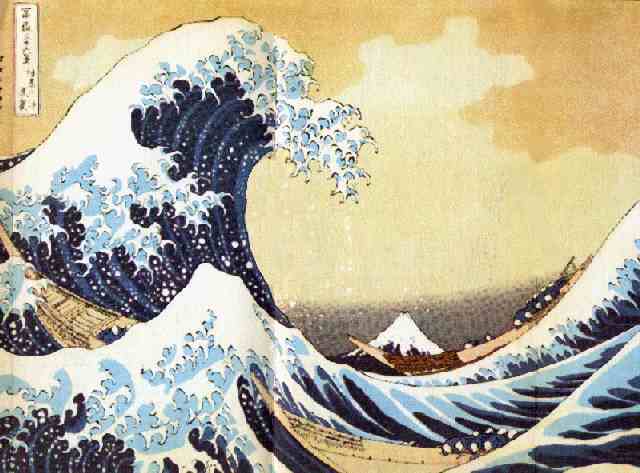 protruding out. One example to the left, is The Great Wave by Hokusai, demonstrating the use of not only woodblocks, yet the power of nature as well. Scrolls were painted and tucked away, used as leisure enjoyments for meditation, similar to the American novel. Quite a few American artists were inspired by the Japanese artists. These paintings held signature view points that were uncommon to the world. This let their paintings put the feel as though the viewer was truly inside the picture, told a sense of motion, portrayed a value of textures, or any number of reasons to demonstrate the culture of perspective. All pictures had some for of nature within, showing it's power and overall control over humankind. This belief derived from the fact Japan consists of many island, being exposed to many natural disasters. Japanese and Chinese art are more different from the wor
 ld than similar, shining their heritages through each masterpiece.
Terracotta soldiers (an exmaple to the right) were made in pieces and put together to be buried with an emperor named Quin Shi Huang Di for afterlife beliefs such as the mummies in Egyptian art. Dry brush, even wash, and graduated brush techniques are used in paintings. Dry brush is used for swift, narrow strokes. Even wash was mainly used in paintings for areas where the color remained the same. Graduated brush gave the picture shadowing for the paint was thick in one line. The painter would go back to this with the wet paintbrush and draw the paint out, making lighter pigments.
I enjoy the flow of these types of Asian art, tranquil spasms of expression. Not all of the art was like this, but the majority is, giving the artists and viewer a sense of relaxation. The forms have a distinct contradiction to the world, letting the viewers defiantly know it's culture. While terracotta soldiers were not peaceful, they have a character that is brought up in each one, so realistically human, it is intriguing. I look forward to making my own soldier, can not wait to learn more about Asian art, and believe painting bamboo is one of the most centering experiences, even though it has nothing to do with who I am. I believe Asian art to be original and am excited. As for my pictures, at the top of the reading, I chose of Japense art and Chinese art, I love the flow yet distortion of the Japanese figure, and the nature of the Chinese art.


 f pyramids, they created temples with columns. These temples usually did not hold doors, having a triangular top. It is called a pediment and told a story in a low relief sculpture, usually about the Greek gods and goddesses. There were three types of columns: Ionic, Doric, and Corinthian. Ionic is simple with curved capitals (the area atop the column). Doric is even simpler, with straight capitals, while Corinthian is delicately decorated with various designs. Above the capital is the abacus and the entablature before the pediment. The abacus supports the entablature and is considered the highest part of the column. The entablature consists of three parts: the architrave, frieze, and cornice. The architrave is next to the abacus, then the frieze, then cornice, before the pediment. Even though most Greek architecture is in ruins today, it is stupefying to think of what amazing structures stood in the past. Re-drawing the school project was interesting, giving is the chance to see our school in a change of light, yet giving us the freedom to make it anything we wanted. The Greeks also influenced the Romans with architecture, using c


 To be honest, this intrigues me very much. I think I would rather get scarification than a tattoo, for I hate needles, but it would be more unique in America. It would be amazing to go to Africa and get a real African to do the process. Something I did not know was Africa was one of the first Christian countries, using the cross in much of their art. Masks were used either to wear around the neck of royalty, or usually for royalty to wear on special occasions. The mask project we did was also quite enjoyable. Out of everything we have done in class so far, even with writing the essay about African art, I believe that was the most successfully taught and had the best projects. I liked the art better than the Egyptian and Prehistoric art. They made sculptures that were realistic, yet idolized. Other sculptures could hold the wood spirits, which were believed ugly yet made beautiful so they would not be offended, the king, and/or people adoring the king. Many natural materials were used such as Ivory to symbolize a number of meanings. Some wooden carvings were believed made by woman long before we realize in the art world, yet we cannot date them. While the art was semi-realistic, it told the roles of genders in the area. Females were more like property, while the man was in charge. The man was the warrior, hunter, protector. The woman was the feminine, nurturing, “mom” type of a woman. Kings would garnish themselves in rich beads with drums surrounding. They would hold weapons, symbolizing power. While this made them seem paralyzed, it held it’s reason, showing the people their leader is vital, giving him the respect her deserves as king.