Monday, May 18, 2009

Post-Impressionism

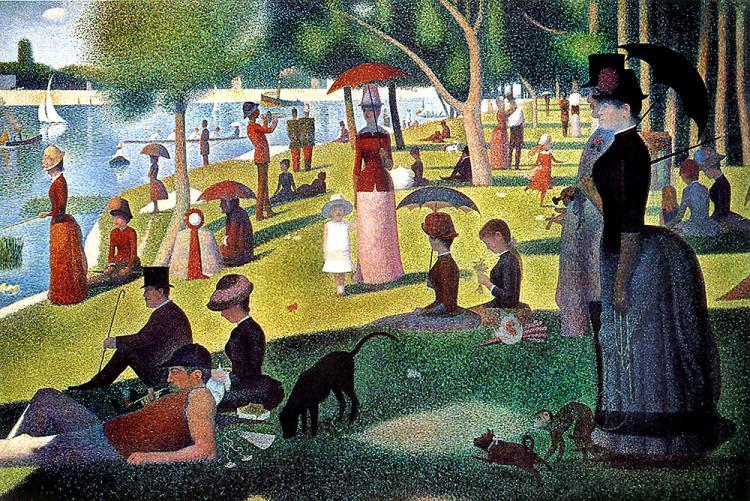
After Impressionism, the Post-Impressionism movement occurred, as the name suggests. Impressionism is very close to Post-Impressionism, for the vivid color usage, thick, swift brush strokes, and the real-life subject matter painted in a dashing method, yet Post-Impressionists used much unrealistic color as well as making the geometric forms more recognizable yet distorted. Some people argue that this artistic time was least significant of them all, while others hold it dear to their hearts. I actually like these works as much as Impressionists, yet I do not find either of them particularly interesting. They are respectable, yet I cannot fathom studying a piece all day. I cannot say I do not like all of them, but I do not fancy most of them. One painting we watched a movie about was called A Sunday Afternoon on the Island of La Grande Jatte. I enjoy the style it was created in, by a famous artist of this time, Georges Seurat, yet do not like the way the people hold themselves. I do not like the colors or the subjects, the lack of movement or pretty much anything else about it. This is why I did not like the movie, for it was all about a painting I could not enjoy as much as others.

Another famous artist during this era was Paul Cezanne. Out of the painters that I know of in this time period, I must say I take pleasure in Cezanne the most. One of his paintings is called The Card Players. I love the expressions on their faces, the colors, the brush strokes, their postures, the hint of a background, the color of the wood, popping out, almost making you smell it.

I am very flip floppy about this movement because I find many pieces I like and dislike, for the others I usually like or dislike in general. It makes it all the more difficult, yet all the more interesting.

Tuesday, May 12, 2009

NYC Class Trip

At New York, we went to the Whitney Museum and MoMA, each having a guided tour then some free time on our own. Within each tour we had a tour guide, Iway and some guy. These people made us look at certain works of art that were controversial as to whether or not they were actually "art". The first painting we discussed at the Whitney was called Woman and Bicycle by an artist named William De Kooning.

Many people cannot tell what this work is, some do not even consider it art. I believe it is art, for the artist created it for some reason. I do not particularly love the piece, yet it deserves a title as artwork. I'm not sure if it is worthy of portraying in a museum, yet who can truly say which artwork is worthy of displaying?
Another area in the Whitney we designated to an artist who got someone to print out documents from the Iraq war. While I believe this has much impact on people and should be displayed somewhere, I do not consider it this artists true artwork, for she simply printed a paper. She did not collage anything, she did not change anything, she simply thought people should read these documents so she printed them.
At the MoMA, some artwork was in question as well. One artist got a person to take a picture of him sitting on a couch with trash bags. Next, he paid a billboard painter to create theses works, yet considered them his own art. I believe the true painter of the art should get credit for the work, and the other artist should get credit for the thought.
One painting I fell in love with at the MoMA was called The Sleeping Gypsy by Henri Rousseau.

I enjoy the crisp, harsh lines, the deep and light contrasting colors, the form of the gypsy as he falls asleep with a lion behind him, wide eyed. I choose to believe the lion as a friend, for the atmosphere is cozy with a full moon tinting the sky with light and a cute, tiny musical instrument sleeping with the gypsy. I stood and studied this painting for a good six minutes, much more than the four seconds Iway said people tend to look at a painting!
And last, but not least, I discovered a culinary art in New York as I munched on the most delicious meat I have ever eaten, Lamb! The perfect ending to the perfect field trip.
Friday, May 8, 2009

Impressionism

Impressionism gave the onlooker more choice how to truly see the painting he or she was gazing at, for it was not painted clearly. Murky outlines, small dabs or spots of color made up a subject that was to be painted, giving the viewer a scene as if he or she was squinting. The subject painted was almost always what was seen, no idealism, no surrealism, simply painting and highlighting the subject usually with sunlight. No only were the brush strokes tiny, they usually were many colors blended together to get a desired effect. While it must take skill to paint something in this way, they are not my favorite genre of paintings.I actually love Renoir's work, yet cannot stand Monet's work. Odd, yet I find his art unattractive to my very soul. I tend to feel a respect for the choice of color and how the painting looks like a photograph when I squint my eyes, yet do not feel a huge bond toward this form of artwork. Monet and Renoir are probably the most known male painters at this time, yet women were beginning to get recognized as well. Cassatt was one of the few women we discussed in class. The women tend to have styles like Renoir and Monet. They must have wanted to be like the most famous, for they were the first females, it must have been intimidating. One year in high school, I went to the Philadelphia Art Museum with French club and studied the Renoir display, for he was French. I like him better than any other Impressionist I have viewed in this class. It amazes me how he became crippled by rheumatism, yet still continued to paint, this time, with the brush tied to his wrist. How difficult that must have been, yet he continued through and did what he had to do, paint. One of the paintings I enjoy by Renoir is Portrait of Claude Renoir Painting.

This painting shows who I assume is a relative of Renoir, for they share the same last name, painting. This boy has such gloss to his hair, the brush stroke illuminating, little detail, yet an "impression" is made that gives the boy certain features like the chub of his cheeks and hands. His shirt had many colors in it, harmoniously flowing together.
Another painting I enjoy is by Mary Cassatt titled, Children Playing. This chub of the children, techniques used, and style are very similar to Renoir.

Both paintings have more solid lines than Monet, which I think I prefer subconsciously. Overall, Impressionism is interesting, as my favorite artist, Dali, began as an impressionist, yet I believe artists need to grow from it and explore other areas, as they should not matter what their favorite type is, yet even more so with Impressionism.

Thursday, April 30, 2009

Caricature

Have you ever been to the boardwalk and have seen a person sitting down as another draws them. You seem a sweet child's face glowing, waiting to see the result of the artist. Peering over his shoulder, instead of seeing something that looks like the fidgety kid, it is a human-like figure with vague connections, exaggerating his poking out ears and bucked teeth, the stain on his shirt and his spiky hair? This is a caricature. While people now create them as silly face, they use to be created as political cartoons, still to laugh at, yet held much meaning. Most of the time, they would target the current ruler and point out his flaws in humorous ways, spreading truth and giggles at the same time.
Honore Daumier was a french print maker, painter, sculptor, and the first caricaturist. One work he created even put him in jail because it was so offensive to the French King at that time. This piece was called Le Charivari and portrayed the ruler as a huge, fat person eating humans and their gold as the tiny, little humans withered away in line. He is going to the bathroom, but instead of what is suppose to come out, laws and other so called "vital" documents were discarded from his rectum, obviously telling Daumier's views of this ruler.

While Daumier created many caricatures, he also created other works of art to show his sympathy for the working, loyal, diligent citizens. One of my favorite pieces I saw at the Philadelphia Museum of art was actually his painting called The Print Lover.

I love creating caricatures, whether happy or mean, they are so much fun. Today was the day we began drawing them, and as I drew my teachers head even larger than normal, I had a blast. They are quick and I am seriously considering being one of those artists sitting on the boardwalk. I will have to practice if I decide this of course, yet it is so much quick, fun, loving art. I love laughing at them too, as I placed hidden meanings in my teacher caricature he will only understand. HAHA!

Realism

Realism began in the mid 19th century when the general people were starting to move to cities. Most of these people became factory workers because of the abundance of factory jobs in the city. They were mostly poor and lived in the slum areas. The other forms of art seemed out of place, so, artists wanting to please their customers, began painting everyday scenes and events exactly as they appeared. There was no idealism here, there was a new form of art, Realism. The famous artist of Realism was Edouard Manet. He believed how he painted was more vital than what he painted. This lead him to re-create scenes that he saw in his everyday life. He created amazing textures, used line often, and put various colors in what each work called for,yet he was most known for using pattern and shape. The following picture is called Portrait of Stephane Mallarm. I enjoy the choppy brush strokes that let you see each one individually, yet as a whole, create a man.

Another artists of this time was actually the first woman artist to be recognized. Her name was Rosa Bonheur, and until her, woman were not thought of artists as highly as men were. She makes her work symmetrical, yet real at the same time. She highlights the main subjects of the painting, like in this work called Couching Lion. I love the true form of the lion and its beautiful face. The fur looks pet-able, the grass looks pick-able, the mountains look close as the others look very far away by using different tints. I love realism and think it is difficult to capture the true form of anything along with its soul, yet Rosa does in this painting quite well.

Landscape Artists

One artist in particular is credited for changing the way landscapes were created. They were no longer simply used as a background, they could be a painting in themselves. This artists name was John Constable. Instead of using quick, swift strokes to simply put the idea of a landscape behind another scene, he put much detail into the nature. He wanted to create a true re-creation of what surrounded him, so he studied the view in many different angles and changes of light. One painting he made was called The While Horse. In earlier times, a white horse would take most of the space in the painting up, yet now, it was only a part of the surrounding landscape.

Another artist of this time was JMW Turner. Instead of adding much detail, he used rapid motion to create forms and areas of color that fit together as a landscape. While Constables work is beautiful, I enjoy Turner's work more. His holds more emotion, capturing the essence of the landscape more than what was seen by the human eye. One I have in my heart is called Rockets and Blue Lights.

Romanticism

When we had to guess what Romanticism was, I believed it was simply something to do with nature, for in literature, that is what it deals with, yet I was wrong. Romanticism portrays dramatic and exotic subjects with intense feeling. I enjoy much of Romanticism and like how the picture holds much motion. The feelings blast out of the artwork, the eye cannot stop swirling around the piece, while the mind think "whoa.." One of my favorite pieces was by an artists named Théodore Géricault, it is titled Raft of the Medusa. We studied this work in class, learned how it showed true historical events. This particular piece showed the result of an incompetent sailor who took many people aboard a ship called the Medusa. He was wealth, yet did not supply enough life boats. Like the Titanic, the poor were left to drown while the rich escaped on a lifeboat. This painting shows the 15 people that survived of the 149 people left on the sinking ship. These 15 people had to do live through horror, even cannibalism. It sickens me to think of such an occurrence, yet the painting turns the rage up on a higher level.

Romantics also used diagonals, the dramatic effects of light, and kinetic energy to bind each painting together. Another artist of this era was Eugeune Delacroix. He throws motion into the pictures, letting the viewer see the figures as they move. One painting he created was called The Death of Sardanapalus. This specific one hold those semi-murky outlines, those vivid colors, those insane actions, letting the imagination continue the story he is telling.